
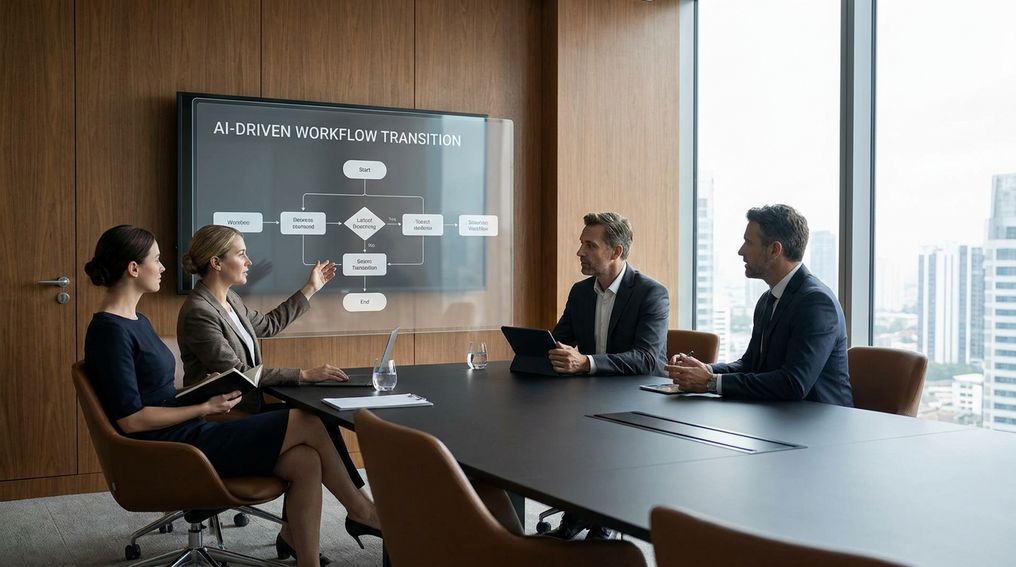
Executive coaching helps leaders manage Artificial Intelligence (AI)-changed workflows by turning technical disruption into clearer decisions, calmer teams, and better human-AI collaboration. Effective coaching leaders AI work gives you a structured way to update how you delegate, decide, measure, and communicate when automation changes daily work.
You may already see the shift: an AI-generated report that used to take a team days, a workflow that now flags exceptions automatically, or a planning cycle where the fastest answer no longer comes from the most senior person in the room. The technical tool is only part of the work. The harder part is leading people through new roles, new doubts, new standards of judgment, and new expectations for speed.
This article explains how executive coaching supports leaders who are managing AI-changed workflows. You’ll see where leadership strain comes from, which skills need attention, how coaching can accelerate adoption, and how to choose a coach who understands technology adoption without treating people like implementation details.
Why Do AI Workflow Changes Strain Senior Leadership?
AI workflow changes strain senior leadership because they alter how decisions get made, who contributes expertise, and how quickly work moves. A leader who built credibility through experience can feel exposed when an AI system produces analysis faster than a traditional team process.
The pressure is real. McKinsey reports that more than half of organizations have adopted AI in at least one function, and many companies plan to increase AI spending. Deloitte also reports that a large share of executives rate AI as a top business priority. That creates a speed gap: leaders are expected to act quickly, yet many still lack a reliable way to lead the human side of adoption.
You’re no longer managing a simple software rollout. You’re managing judgment, trust, workflow redesign, team morale, and accountability at the same time. If a system drafts recommendations, who reviews them? If automation reduces manual work, how do roles change without damaging confidence? These questions require leadership discipline, not just technical training.
Executive coaching gives you a private, structured space to examine these pressures before they turn into reactive decisions. It helps you name what’s changing, separate personal discomfort from business risk, and communicate the shift with more steadiness. That matters when your team is looking to you for cues about whether AI is a threat, a shortcut, or a tool that needs thoughtful use.
What Are The Biggest Leadership Challenges In AI-Changed Workflows?
The biggest leadership challenges are resistance, role confusion, trust in AI outputs, team anxiety, and unclear accountability. These issues show up fast when workflows change faster than people can process what those changes mean.
Resistance often comes from a loss of control. Senior leaders may be used to reviewing the full path from input to decision, but AI can compress that path into outputs that feel sudden or opaque. Teams may also worry that automation will make their judgment less valued. If you treat these reactions as stubbornness, you miss the real signal: people need clarity about where human expertise still matters.
Skill redefinition adds another layer. Salesforce research notes that many business leaders expect AI to change the skills employees need. That means you’re not just assigning new tools; you’re redefining capability. A finance leader may need to shift from building reports to questioning model assumptions, and an operations leader may need to compare machine-generated patterns with lived process knowledge.
Accountability can also become blurry. If an AI-assisted workflow recommends a hiring screen, sales action, risk flag, or customer response, people need to know who owns the final call. Coaching helps you build the leadership habit of asking better questions: What is the system allowed to decide? Where must a person review the output? What evidence earns trust?
What New Skills Do Executives Need For Human-AI Collaboration?
Executives need adaptive decision-making, AI literacy, emotional intelligence, systems thinking, and stronger communication skills. These skills help you lead work where human judgment and machine-generated output must operate together.
AI literacy does not mean becoming a data scientist. It means understanding what the tool is designed to do, where it can fail, what data it uses, and what level of review is needed. You need enough fluency to ask useful questions without pretending every decision is technical. That balance protects you from blind trust on one side and blanket skepticism on the other.
Emotional intelligence matters because AI adoption changes how people see their own value. Employees may ask whether their experience still counts, whether speed will replace quality, or whether leaders are using AI to cut people out of decisions. A coached leader learns to address those concerns directly without overpromising. Calm communication reduces rumor-driven behavior and makes adoption easier to manage.
You also need sharper prioritization. AI can generate more options, more summaries, and more signals than a team can act on. The leader’s job becomes choosing what deserves attention, what needs human review, and what should be ignored. Coaching leaders AI adoption well means strengthening your ability to decide under information overload, not chasing every new output because it looks sophisticated.
How Does Coaching Leaders AI Build These Capabilities Faster?
Coaching leaders AI adoption builds capability faster by turning broad change goals into specific leadership behaviors. Instead of saying, “Be more adaptable,” coaching helps you practice how to question outputs, reset team expectations, and lead difficult conversations.
Executive coaching is already common in management development. International Coaching Federation research reports that many global organizations offer coaching to managers and executives, and coaching recipients often report improved work performance and increased self-confidence. That matters in AI-changed workflows because confidence affects the speed and quality of leadership decisions. Leaders who feel overwhelmed tend to delay, over-control, or delegate without enough guidance.
A coach helps you identify your default response to AI-related uncertainty. You may over-rely on technical experts, avoid hard role conversations, dismiss employee concerns, or push adoption before your team understands the reason behind it. Once that pattern is visible, you can replace it with a better behavior. The value comes from repeated reflection, planning, action, and review.
Coaching also creates a bridge between strategy and daily behavior. A board or executive team may approve an AI initiative, but adoption succeeds or stalls inside meetings, reviews, handoffs, and performance conversations. Your coach can help you redesign those leadership moments. That is where AI transformation becomes visible to employees.
Which Coaching Methods Work Best For AI-Driven Change?
The best coaching methods for AI-driven change combine goal setting, stakeholder feedback, reflective practice, scenario planning, and behavior measurement. These methods work because AI adoption requires new habits, not just new information.
Goal setting should connect directly to the changed workflow. A useful coaching goal might focus on improving decision quality in AI-assisted planning meetings, reducing escalation delays in automated exception handling, or increasing manager confidence during role redesign. Vague goals make coaching feel disconnected from business needs. Specific goals help you compare progress against the work that changed.
Stakeholder feedback is useful when AI adoption affects several groups. Your direct reports, peers, technical leads, and human resources partners may each see a different version of your leadership. A coach can help you interpret that feedback without becoming defensive. The point is to find behavior patterns that help or block adoption.
Scenario planning is especially useful for skeptical leaders. It lets you rehearse decisions before pressure rises. You can examine what you’ll do if employees reject a new tool, if AI output conflicts with senior judgment, if productivity improves but morale drops, or if accountability is unclear. These rehearsals make real leadership moments less reactive.
How Do You Measure Coaching Impact During AI Adoption?
You measure coaching impact by tracking leadership behaviors, adoption quality, decision speed, team confidence, and workflow outcomes. The strongest measures connect coaching goals to real work changes rather than broad satisfaction scores alone.
Start with baseline questions. How often are AI outputs reviewed before action? How long do escalations take? Do managers understand where human approval is required? Are employees using the workflow correctly, bypassing it, or waiting for senior leaders to decide? These questions give you a practical starting point.
You can also measure changes in leadership behavior. Look at meeting quality, clarity of decision rights, communication consistency, manager readiness, and the number of unresolved concerns that keep resurfacing. If coaching is working, you should see fewer vague objections and more specific, workable questions from the team. That shift matters because it shows people are moving from fear to informed participation.
Return on Investment (ROI) can be difficult to isolate because AI adoption includes tools, training, process redesign, and coaching. Still, coaching can be tied to adoption milestones, retention of key talent, reduced rework, and better manager execution. International Coaching Federation and Human Capital Institute research has reported a positive average return for coaching investment. Use that kind of data as a reference point, then define measures that fit your organization’s workflow goals.
How Do You Choose An Executive Coach For AI-Augmented Leadership?
Choose an executive coach who understands leadership behavior, change management, human-AI collaboration, and senior-level accountability. The coach does not need to build AI systems, but they should understand how AI changes decisions, roles, and trust.
Ask how the coach works with technology adoption. Strong answers will mention stakeholder alignment, decision rights, resistance, communication, behavior change, and measurement. Be cautious if the conversation stays only at the level of motivation or generic leadership style. AI-changed workflows require more precision than that.
Look for a coach who can work with technically oriented executives. Some leaders view coaching as too soft for operational change, so the coach needs to connect behavior to measurable business outcomes. That includes faster decisions, better escalation habits, stronger manager readiness, and clearer accountability. Coaching should feel practical, not abstract.
You should also ask how confidentiality and organizational goals will be balanced. The leader needs a private space to examine doubts and blind spots, and the organization needs visible progress tied to adoption. A good engagement defines goals up front, sets review points, and avoids turning coaching into a reporting tool. That balance protects trust and keeps the work useful.
How Executive Coaching Helps With AI-Changed Workflows
- Builds adaptive human-AI decisions
- Reduces resistance to AI adoption
- Strengthens team communication
- Clarifies accountability
- Supports calmer change leadership
Lead The Workflow, Not Just The Rollout
AI-changed workflows ask leaders to do more than approve tools and track adoption dashboards. You need to decide where human judgment belongs, explain role changes with care, and create enough trust for people to use new systems without surrendering responsibility. Executive coaching gives you a disciplined way to build those habits under pressure. The best coaching leaders AI work connects leadership behavior to real workflow outcomes: better decisions, clearer accountability, stronger morale, and steadier execution. If AI is changing how your organization works, your leadership operating style needs to change with it.
References
- International Coaching Federation — Global Coaching Study
- McKinsey & Company — The State Of AI: Generative AI’s Breakout Year
- Deloitte — Global Human Capital Trends
- PricewaterhouseCoopers (PwC) — Global Workforce Hopes And Fears Survey
- Harvard Business Review — How AI Is Redefining Leadership
- Forbes — The Role Of Executive Coaching In The Age Of AI
- International Coaching Federation And Human Capital Institute — ROI Of Coaching.