
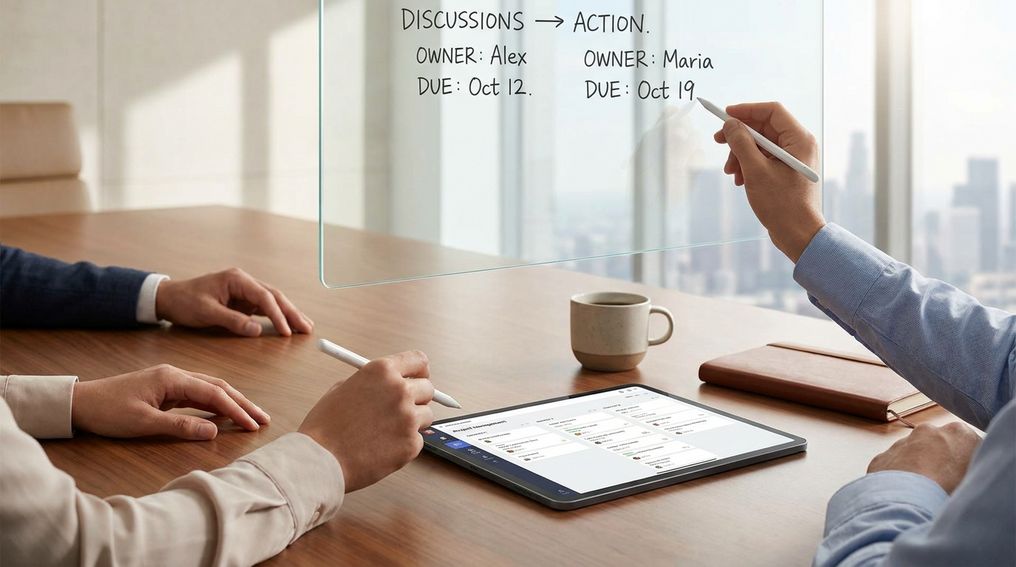
Accountability without ownership turns meetings into recurring conversations where people report status, agree on tasks, and still leave no one responsible for the outcome. A meeting creates value only when every decision and follow-up has a named owner, a deadline, and the authority to move the work forward.
You’ve seen the pattern: the team discusses the same issue again, agrees that “someone should follow up,” and schedules another call to revisit it. This article explains why that happens, how accountability differs from ownership, and how you can redesign meeting habits so action survives after the calendar invite ends.
Why Do Meetings Feel Like A Waste Of Time?
Meetings feel like a waste of time when they create conversation without ownership. If no one leaves with a clear decision, a named next action, and permission to act, the meeting becomes a loop.
Meeting overload is not just a scheduling problem. Research from Doodle found that many office workers attend meetings they consider wasted time, and Atlassian reported that employees lose many hours each month to unproductive meetings. Microsoft also found that many people lack enough uninterrupted focus time, with inefficient meetings named as a top barrier.
The hidden cost is not only the meeting itself. It’s the recovery time, the repeated explanations, the Slack threads, the follow-up emails, and the second meeting created to fix what the first meeting failed to settle. When your team keeps revisiting the same topic, the calendar is showing you a process problem.
A useful meeting has a job. It exists to decide, align, solve, review, or build. If the meeting’s only output is “let’s circle back,” you have activity without movement. That’s where accountability without ownership starts to drain energy.
What Is The Difference Between Accountability And Ownership?
Accountability means someone can be asked to report on progress or explain an outcome. Ownership means someone accepts responsibility for moving the outcome to completion, including decisions, coordination, and follow-through.
Accountability often sounds clean in a meeting note: “Jordan to follow up,” “Marketing to review,” “Operations to confirm.” The problem is that those lines can describe reporting duties, not real authority. A person can be accountable for giving an update without owning the work required to make that update meaningful.
Ownership carries a different weight. The owner defines the next move, gathers input, resolves blockers, and returns with a decision or completed action. They don’t wait for another meeting to ask what should happen next. They know what success looks like and what they’re allowed to decide.
This distinction matters because teams often confuse task assignment with outcome ownership. A task owner may send the email. An outcome owner makes sure the decision lands, the right people respond, the blocker gets removed, and the work reaches the agreed finish line.
Where Do Meetings Break Down When No One Owns The Outcome?
Meetings break down at the point where discussion turns into action. If the group leaves without one owner for each outcome, responsibility gets spread so thin that no one feels responsible enough to act.
The ownership gap often appears in friendly language. “We should look into that.” “Can someone check?” “Let’s all review the doc.” Those phrases sound cooperative, but they hide the person who must drive the work. Shared interest is useful; shared ownership without a lead owner is where follow-through gets blurry.
Another breakdown happens when meetings mix decision-making with status reporting. A status meeting can surface information, but it rarely creates movement unless someone has the authority to make the call. McKinsey has noted that executives spend many hours in meetings, yet much of that time does not turn into action. That gap shows up when discussion replaces decision ownership.
You can spot the problem by checking the meeting notes. If the notes are full of topics and light on owners, dates, and decisions, the team has documented the conversation rather than the work. Good notes should read like a transfer of responsibility, not a transcript.
What Does Accountability Without Ownership Do To A Team?
Accountability without ownership creates delays, repeated meetings, weak follow-through, and blame after missed outcomes. It turns responsibility into a performance of reporting rather than a practice of completing.
The first effect is decision drift. The team believes something was handled because it was discussed, but the action never gets enough force behind it. Project.co reported that many meeting action items are not completed or are forgotten, which matches what many teams experience: action items disappear when nobody owns the result.
The second effect is morale loss. People stop trusting meetings when the same topics return week after week. They begin to protect their time, multitask during calls, or disengage from planning conversations. Gartner’s research on human resources priorities points to unclear ownership of tasks as a source of disengagement and weak action after planning.
The third effect is blame. When deadlines slip, the team searches backward for who was supposed to do what. That creates defensiveness, not progress. Real ownership prevents that pattern by making responsibility visible before the work begins, not after it fails.
How Do You Assign Clear Ownership In A Meeting?
You assign clear ownership by naming one owner for every decision or follow-up, defining the expected outcome, setting a due date, and confirming the owner has authority to act. If any of those parts are missing, the assignment is incomplete.
Start with one owner, not a group label. “The product team owns this” is weaker than “Priya owns the decision and will return with a recommendation by Friday.” Group labels are useful for routing work, but they don’t drive accountability. A named owner gives the team a single point of coordination.
Then define the outcome, not just the activity. “Review the proposal” is vague. “Approve, reject, or return edits on the proposal” is actionable. The owner should know whether they are expected to inform the group, make a decision, remove a blocker, deliver a draft, or secure approval.
End by confirming authority. If the person owns the action but cannot make decisions, access information, or get support from others, you have assigned pressure without power. Ownership works when responsibility and authority match.
How Can RACI Or DACI Reduce Meeting Confusion?
Responsible, Accountable, Consulted, and Informed (RACI) or Driver, Approver, Contributors, and Informed (DACI) can reduce confusion by separating who does the work, who approves, who advises, and who only needs updates. Use them lightly so they create clarity without slowing the team down.
RACI helps when tasks involve several functions. The responsible person completes the work, the accountable person owns the outcome, consulted people give input, and informed people receive updates. The value is not the chart itself. The value is the conversation that prevents five people from assuming someone else has the lead.
DACI works well for decisions. The driver moves the decision forward, the approver makes the final call, contributors provide needed input, and informed people stay aware. This model helps stop the common meeting problem where everyone debates, no one decides, and the topic comes back again.
Keep the tool smaller than the work. You don’t need a formal matrix for every routine task. You do need role clarity when decisions cross teams, carry risk, affect customers, or require trade-offs. Use the lightest structure that makes ownership visible.
How Do You Make Meeting Follow-Ups Actually Happen?
You make follow-ups happen by recording ownership publicly, attaching dates to outcomes, and starting the next meeting by reviewing completed commitments. Follow-through improves when ownership is visible to the group.
A strong action item has four parts: owner, outcome, date, and decision rights. “Sam owns vendor shortlist by Thursday and can choose the top three options for review” is much better than “Sam to check vendors.” The second version leaves room for delay, rework, and unclear expectations.
Public commitment matters. When the owner says the commitment out loud or confirms it in writing, the group leaves with a shared record. Harvard Business Review has connected decision ownership with execution, and that point fits the daily reality of meetings: people act faster when ownership is named before the work leaves the room.
Review commitments with discipline. Don’t shame people for misses, but don’t let missed work vanish. Ask what changed, what support is needed, and whether the owner still has the right authority. This keeps accountability tied to problem-solving rather than blame.
How Do You Build An Ownership-Driven Meeting Culture?
You build an ownership-driven meeting culture by rewarding completion, reducing performative attendance, and making decision ownership a normal part of every agenda. Ownership must be practiced outside the meeting, not just assigned inside it.
Start by changing what gets praised. Many teams reward availability: joining every call, commenting on every document, staying visible. Ownership culture rewards completed decisions, removed blockers, clean handoffs, and reliable follow-through. That shift tells people that action matters more than presence.
Then clean up your meeting cadence. Cancel meetings that do not need a live conversation. Replace status updates with written updates when no decision is required. Reserve meeting time for choices, trade-offs, alignment, and problem-solving that benefits from real-time discussion.
Leaders set the standard by refusing vague endings. Before a meeting closes, ask: who owns this, what will be done, by when, and what authority do they have? If the group cannot answer, the meeting is not done. It may be over on the calendar, but the work has not been transferred.
What Happens When There Is Accountability Without Ownership?
- Meetings become talk shops
- Outcomes have no clear owner
- Decisions stall
- Follow-ups get forgotten
- Blame replaces action
Make Every Meeting Carry A Name And A Date
Accountability without ownership turns your calendar into a holding pattern. To break that pattern, make every meeting prove its value through named owners, clear outcomes, decision rights, and visible follow-through. You don’t need more complicated meeting rules; you need cleaner transfers of responsibility. When people know what they own, what they can decide, and when the work is due, meetings stop recycling the same topics. The best meeting culture is not the one with the most polished agenda, it’s the one where decisions leave the room with someone ready to move.
References
- Doodle — State Of Meetings Report
- Atlassian — Time Wasting At Work Infographic
- Microsoft — Work Trend Index
- McKinsey & Company — If We’re All So Busy, Why Isn’t Anything Getting Done?
- Harvard Business Review — To Get Results, The Best Leaders Push And Support Their Teams
- Gartner — Top Priorities For Human Resources Leaders
- Project.co — The State Of Meeting Action Items
- Forbes — The Difference Between Accountability And Ownership.