
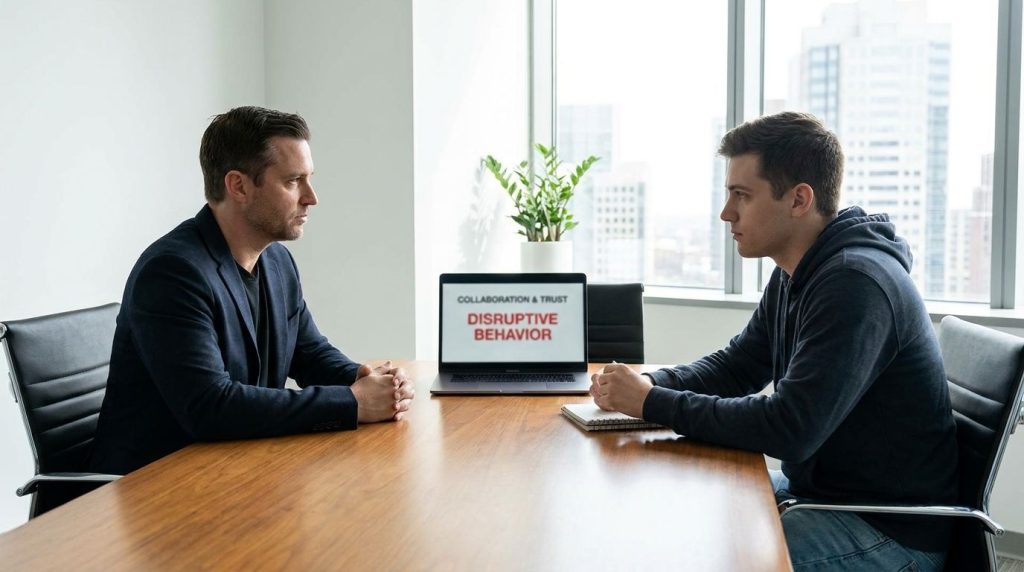
To manage the genius who is a toxic teammate, treat the behavior as a performance problem, not a personality quirk. Define the specific damage, give direct feedback, set measurable expectations, protect the team, and act if the person does not change.
A toxic high performer can look valuable when you measure only individual output, yet cost the team through rework, silence, burnout, attrition, and lost ideas. This article helps you decide when to coach, when to contain the damage, and when to remove the person from the team without confusing brilliance with true performance.
What Makes A “Genius” Teammate Toxic?
A genius teammate becomes toxic when their behavior repeatedly makes other people less able to contribute. The issue is not that they are intense, direct, ambitious, or exacting. The issue is a pattern of conduct that leaves teammates afraid to ask questions, challenge decisions, admit mistakes, or share work early. When that pattern appears, you are no longer managing a quirky top performer; you are managing a team risk.
Keep the definition behavioral. Toxic workplace behavior includes actions that make employees feel belittled, unvalued, undermined, or unsafe at work. In practical terms, that can mean interrupting people, mocking questions, withholding information, blaming others publicly, dismissing peer review, taking credit, or using expertise to shut down discussion. The label matters less than the effect: fewer voices, slower learning, weaker decisions, and less trust.
You also need to separate high standards from harmful conduct. A demanding teammate can challenge weak reasoning, ask for better evidence, and push for quality without attacking the person doing the work. A toxic teammate turns disagreement into humiliation or control. If people prepare more for the person’s reaction than for the actual work, the team has already started paying the price.
Why Individual Brilliance Can Hide Team Damage
Individual output can be easy to see. Team damage is usually quieter. The toxic teammate ships code, closes accounts, solves hard problems, or keeps a legacy system alive, so senior leaders see visible results. What they may not see is the meeting where others stopped speaking, the junior employee who stopped asking for review, or the experienced teammate who began looking for another role.
Research on toxic workers challenges the idea that one star can offset broad damage. Work by Michael Housman and Dylan Minor examined more than 58,000 hourly service workers across 11 firms and found that toxic workers can appear productive in the short term yet create costs through lower-quality work, spread of poor behavior, and weaker customer satisfaction. Harvard Business School’s summary of that research reported that avoiding a toxic worker can be worth more than adding a superstar, using a cost comparison of toxic-worker replacement and top-one-percent productivity value.
The math gets uncomfortable fast. If one person’s output causes five people to contribute less, the apparent win may disappear. Incivility also consumes time because employees replay conversations, avoid the person, seek reassurance, document defensively, or work around knowledge gaps. Managing a toxic high performer starts with seeing those hidden costs as business costs, not soft complaints.
Stop Treating It As A Personality Problem
Do not build the conversation around whether the person is “nice,” “abrasive,” or “just that way.” Those words invite debate and defensiveness. Build it around job expectations and observable behavior. A toxic teammate may argue with your interpretation, but it is harder to argue with clear examples tied to business impact.
Performance has two sides: what gets delivered and how work gets done. If the role requires collaboration, mentoring, review, handoffs, shared decision-making, or cross-functional trust, then behavior is part of the job. You are not adding an extra standard after the fact. You are clarifying that a person who damages the system they work in is not fully meeting the role.
Use plain examples in your records and conversations. “You interrupted three people before they finished their estimates” is stronger than “you dominated the meeting.” “You refused to document the deployment process after two requests, which delayed the backup owner” is stronger than “you hoard knowledge.” Specific language lowers drama and raises accountability.
Diagnose The Pattern Before You Act
Before you decide on coaching, reassignment, or removal, diagnose what is happening. Some toxic behavior comes from lack of awareness, poor incentives, stress, weak norms, or a manager who rewarded output without naming the cost. Some comes from entitlement, control, retaliation, or a refusal to respect boundaries. The response should fit the pattern, not your frustration level.
Start by gathering specific examples from your own observations, project records, meeting notes, peer feedback, and business outcomes. Look for repeat behavior across settings. A single bad meeting calls for correction; a repeated pattern of intimidation, belittling, sabotage, or knowledge control calls for formal management action. Also check whether the person behaves differently upward than sideways or downward, because charm with leaders can hide damage among peers.
Ask whether your team norms are clear enough to enforce. If your organization praises “candor” but never defines respectful disagreement, the toxic teammate may claim permission to be harsh. If bonuses, promotions, or project control reward individual heroics without collaboration, the system is feeding the behavior. You can still hold the person accountable, but you also need to remove the mixed messages that protect them.
Have The Direct Conversation Early
Do not wait until the team is exhausted before giving direct feedback. The longer you delay, the more the team concludes that output matters more than respect. The toxic teammate also loses the chance to correct course before consequences become larger. Early feedback is fairer to the person and safer for the team.
Use a simple structure: name the contribution, name the behavior, name the impact, name the expectation, and ask for commitment. You could say: “Your technical contribution is strong. In yesterday’s planning meeting, you interrupted two teammates and dismissed their estimates before they finished. That reduced the team’s ability to test assumptions. In this role, strong performance includes challenging ideas without shutting people down. What will you do differently in the next planning meeting?”
Keep the tone calm and firm. Do not over-explain, soften the message until it loses meaning, or bargain with the standard. If they say, “People are too sensitive,” bring the conversation back to business behavior: “The requirement is not that everyone agrees with you. The requirement is that people can raise risks, ask questions, and disagree without being belittled.” That line keeps the focus on job performance.
Set Non-Negotiable Behavioral Expectations
Once the pattern is clear, set expectations that can be observed and measured. Do not tell the person to “be more positive” or “work on attitude.” Tell them what must stop, what must start, and how follow-up will happen. Vague expectations create loopholes; specific expectations create accountability.
Useful expectations include no interrupting or belittling, challenge ideas without attacking people, share information needed for handoffs, document critical processes, accept peer review, invite dissent before final decisions, and respond to feedback without retaliation. You can also set meeting rules, decision rules, documentation requirements, and review checkpoints. These are not manners lessons. They are operating standards for a team that needs speed, accuracy, and trust.
Tie the expectations to real consequences. Project ownership, promotion readiness, bonus discussions, leadership scope, and continued employment can all depend on how the person affects the team. Harvard Business Review’s guidance on alienating top performers supports making people accountable for how they deliver, not just what they deliver. The message should be direct: collaboration and respect are not optional extras.
Coach Only When There Is Evidence Of Change
Coaching is appropriate when the person accepts feedback, can describe the impact of their behavior, agrees to specific changes, and shows progress over time. A brilliant teammate who says, “I did not realize I was shutting people down; here is what I’ll change,” deserves a structured chance to improve. Pair feedback with regular check-ins, targeted practice, and visible behavior markers. The goal is not personality change; it is reliable workplace behavior.
Coaching is not enough when the person denies every example, retaliates against feedback, keeps intimidating teammates, or uses expertise to make the team dependent. Defensive reactions are normal in a first conversation. Ongoing denial after clear feedback is different. If nothing changes, more coaching can become avoidance disguised as patience.
Measure change through behavior, not promises. Are meetings safer for disagreement? Are handoffs documented? Are peers participating again? Are decisions improving because more people can contribute? If the answer stays no, you need a stronger intervention.
Protect The Team While The Person Improves
Never make the rest of the team wait unprotected for one person to mature. During a coaching period, reduce dependency and limit damage. Rotate ownership, document critical systems, create backup owners, and make important decisions visible. A toxic genius becomes harder to manage when they are the only person who knows how something works.
Use structure to reduce opportunities for domination. Send agendas before meetings, assign facilitation, use written input before discussion, and require decisions to include dissenting risks. If the person tends to overpower live conversation, written pre-work gives quieter teammates a fairer path to contribute. Structured peer review can also prevent one person from controlling quality standards by force of personality.
Check in with affected team members without asking them to manage the problem for you. Ask what behavior they are seeing, what work is blocked, and whether retaliation or avoidance is occurring. Do not turn private complaints into gossip. Your job is to verify patterns, act on observable impact, and show the team that standards are real.
Document Behavior, Not Vibes
Documentation protects the team, the organization, and the employee receiving feedback. It also keeps you honest. If you cannot describe the behavior clearly, you are not ready to escalate it. Strong documentation turns a vague concern into a record of performance impact.
Record the date, setting, specific behavior, people or work affected, prior feedback given, expected change, and follow-up result. Write “interrupted two teammates during project estimation and rejected their input before they completed their risk assessment,” not “bad attitude.” Write “deployment handoff was delayed because required documentation was not provided after two requests,” not “not a team player.” The stronger your facts, the less you need labels.
Documentation should include positive change as well. If the person improves, capture it. If they relapse, capture that too. The purpose is not to build a secret file; the purpose is to create a fair, accurate record that supports coaching, role changes, escalation, or removal when needed.
Know When To Remove The Person
Removal becomes the right business decision when the behavior continues after clear expectations, coaching, and fair warning. It is also appropriate when the behavior includes retaliation, intimidation, sabotage, or conduct that puts people or business outcomes at serious risk. You do not need to wait for the entire team to burn out before acting. A manager’s responsibility includes protecting the system, not just preserving one person’s output.
Keeping the toxic teammate sends a message. It tells the team that results excuse harm, values are negotiable, and the safest move is silence. Gallup research on unethical behavior and manager response supports the broader point that leadership action shapes what employees believe is tolerated. What you permit becomes the real standard.
Plan the transition carefully. Capture knowledge, assign backup ownership, communicate work changes, and support the people who absorbed the damage. Do not frame the move as punishment in team conversations. Keep communication professional: the team is resetting expectations, protecting work quality, and making collaboration part of performance.
Rebuild The Culture Afterward
After a toxic high performer changes roles or leaves, the work is not finished. The team may still be cautious, quiet, or skeptical. People may have learned that speaking up carries risk or that leadership responds only after damage becomes visible. Rebuilding trust requires consistent behavior from you.
Restate team norms in concrete terms. Challenge ideas directly, share information early, document handoffs, disagree without personal attacks, and raise risks before decisions lock. Recognize the people who kept work moving without drama. Make collaboration visible in performance reviews, project selection, and promotion discussions so the next talented person does not learn the wrong lesson.
Psychological safety does not mean comfort or low standards. It means people can take interpersonal risks, ask questions, admit uncertainty, and challenge decisions without fear of being punished or humiliated. Google’s team-effectiveness work and Harvard Business School’s writing on psychological safety both support the value of candor without fear. A team that can speak honestly will usually find problems faster than a team organized around one intimidating expert.
How Do You Manage A Toxic High Performer?
- Document specific behavior and business impact.
- Give direct feedback.
- Set measurable expectations.
- Coach only if behavior changes.
- Protect the team if it does not.
The Real Standard: Talent That Raises The Team
To manage the genius who is a toxic teammate, stop asking whether the person is too valuable to confront and start asking whether their value survives a full team-impact review. True performance includes quality, speed, trust, learning, handoffs, judgment, and the ability to make others better. Some brilliant people can change when you give clear feedback, real support, and non-negotiable standards. Others will keep costing the team more than they produce. Your job is to make that cost visible, act early, and protect the kind of workplace where strong people can do their best work without fear.
References
- Harvard Business School Working Knowledge — Hazard Warning: The Unacceptable Cost of Toxic Workers
- Kellogg Insight — Hire a Superstar or Dump a Toxic Worker?
- Harvard Business School Faculty & Research — Toxic Workers
- McKinsey Health Institute — Addressing Employee Burnout: Are You Solving The Right Problem?
- Society for Human Resource Management — Civility Index
- Gallup — State Of The Global Workplace 2026 Global Data Summary
- Gallup — Employees Want A Lot More From Their Managers
- Gallup — The Strengths, Weaknesses And Blind Spots Of Managers
- Gallup — Most Unethical Behavior Goes Unreported And Unresolved
- Google re:Work — Understand Team Effectiveness
- Harvard Business School Working Knowledge — Four Steps To Building The Psychological Safety That High-Performing Teams Need
- Harvard Business Review — Managing A Top Performer Who Alienates Their Colleagues
- Harvard Business Review — How To Manage A Toxic Employee
- Netflix — The Best Work Of Our Lives.