
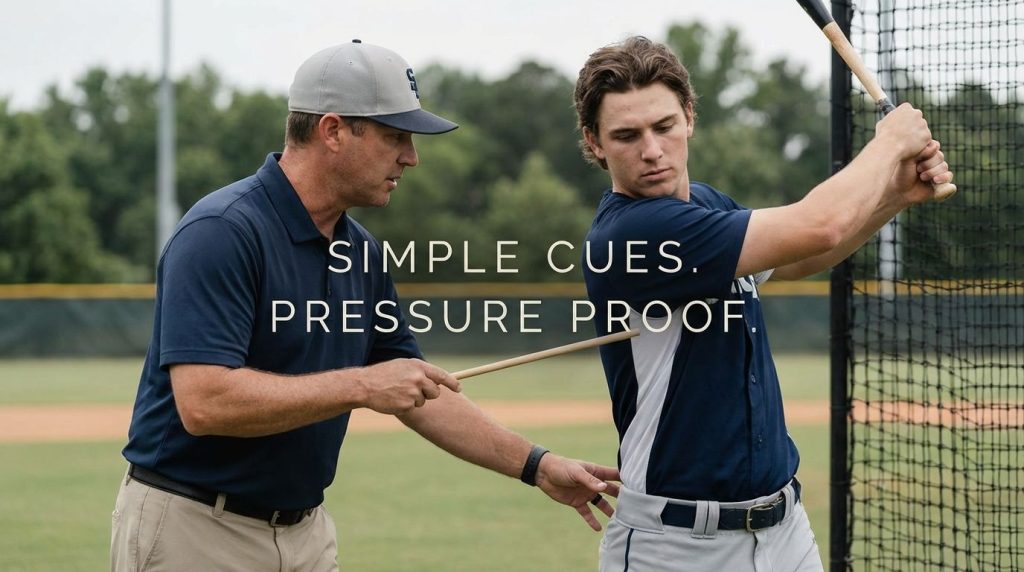
You can’t “fix” mechanics on demand because you’re not repairing a machine, you’re rewiring a motor pattern that only holds up when attention, pressure, and task demands match real play. When the move looks clean in drills but falls apart in competition, the issue is usually transfer, cueing, timing, or attentional overload, not effort or toughness.
This gives you a coach-ready explanation for why progress feels non-linear, why athletes revert in games, and why the same mechanical cue can work on Tuesday then fail on Saturday. You’ll leave with practical ways to cue less, stabilize more, pressure-proof changes, and decide when to stop tinkering and let the athlete compete.
Why Does It Feel Like You Can’t Fix A Player’s Mechanics Even When The Drills Look Good In Practice?
Practice can produce a “temporary performance upgrade” that doesn’t count as learning yet. When the environment is calm, feedback is constant, and the drill is predictable, athletes can assemble a movement with conscious control and get a clean-looking rep. That can fool everyone, coach included, into thinking the change is installed.
Then the athlete goes to a course, a game, a live bullpen, a scrimmage, a tryout, a tournament, or even just a range session with different targets. Speed goes up, decisions show up, outcomes start to matter, and the body reaches for the most stable pattern it owns. The new pattern hasn’t earned “automatic status,” so it drops out when attention gets pulled away.
This is why athletes describe the same storyline across sports: “It looked great in the lesson, then I lost my swing,” “I can’t find contact,” “the ball is going everywhere,” “I’m off balance,” “I’m thinking too much.” You’re seeing a transfer problem, not a competence problem.
Coach it like a transfer problem. Install changes with variability, game-like timing, and fewer “perfect rep” expectations. Then measure retention by what shows up after a day off, in a different setting, with a different club or bat, with a different pitch speed, with a different lie, with different fatigue, and with fewer reminders.
Is The Problem Your Coaching Cues, Too Many “Body Part” Instructions?
Yes, a lot of the time it is. Internal cues, the body-part directions like hips, elbow, wrist, shoulder plane, head still, keep your back angle, often pull the athlete’s attention into conscious control. That can create an immediate “looks better” effect, then a long-term “falls apart under pressure” effect.
External focus cues work because they aim attention at the outcome or the movement effect, not the movement parts. The athlete organizes the movement without micromanaging it. The research on attentional focus repeatedly shows better performance and learning outcomes when attention is directed externally rather than internally, and the constrained action hypothesis explains why internal focus can interfere with automatic control.
That doesn’t mean mechanics talk gets banned. It means mechanics talk gets rationed. Use internal cues to diagnose and shape, then hand the athlete one external cue to run. If three body parts are getting coached at once, the athlete is playing a memory game, not a sport.
Operational rule: when the athlete is moving, cue the task. When the athlete is stopped, teach the position. When play starts again, return to one task cue that the athlete can execute at speed.
Why Does A Player Revert To Old Mechanics In Games Or When The Stakes Rise?
Reversion is the brain choosing the safest program under uncertainty. Under stress, attention narrows, muscles tighten, tempo changes, and athletes start “checking” the movement in their head. That pushes attention inward, increases conscious monitoring, and disrupts automatic timing.
Skill breakdown under pressure often maps to explicit monitoring, reinvestment, and skill-focused attention concepts in motor performance research. When athletes reinvest, they burn working memory on movement control instead of reading the environment, tracking the ball, or committing to the target. The more complicated the instruction set, the easier it is for pressure to trigger that internal monitoring loop.
On the field, this presents as late swings, rushed transitions, steering the ball, decelerating through contact, “guiding” the club or bat, and freezing at launch. Video can mislead you here because the athlete might still look close to the model, yet the timing and sequencing are off by a fraction.
Coach response: remove options. One cue, one tempo anchor, one decision rule. If the athlete is thinking about mechanics in the box or over the ball, the plan is already too complex.
How Do You Know If It’s A Mechanics Issue Or A Mental Issue Like Choking?
The fastest filter is situation dependency. If the athlete looks functional in low-stakes reps, then collapses in scorekeeping, observers, selection pressure, or late-in-game moments, mechanics are not the only driver. Attention and pressure are changing the control strategy.
If the athlete breaks down everywhere, even in relaxed short reps, then yes, mechanics, strength, mobility, pain, vision, or equipment can be primary drivers. If breakdown shows up mainly when it matters, treat it as an attention and routine issue that is interacting with mechanics.
Reinvestment research connects a tendency toward conscious motor processing with perceived choking under pressure in skilled performers. That matters because some athletes are more “mechanics-prone” under stress than others. Those athletes need fewer cues, clearer routines, and practice conditions that force attention outward.
Coach response: don’t label it as “mental” in a way that blames the athlete. Label it as “attention under pressure.” Then build a plan that makes attention predictable: pre-shot, pre-pitch, pre-swing routines, one external cue, and a commitment rule that ends analysis once movement starts.
Should You Keep Fixing Mechanics Mid-Season Or Stop Tinkering And Just Let Them Play?
Mid-season is not a moral issue, it’s a risk management issue. A major rebuild can improve the long-term ceiling, but it can also create short-term instability that costs performance, confidence, and buy-in. If the athlete is competing weekly, the window for messy reps shrinks fast.
If the athlete is losing basic function, confidence, or enjoyment, shift to performance mode. That means stabilizing contact, tempo, and decision speed with minimal cueing. Save deeper rebuild work for periods when results don’t carry the same consequences.
You can still develop in-season with the right boundaries. Keep one development objective that is practiced off the field, off the course, or in controlled sessions, then keep games simple. Many community coaching discussions echo this same point: too many changes mid-season often create confusion and lost timing, especially for youth athletes.
A practical compromise is a two-lane plan. Practice lane: explore, exaggerate, film, and drill. Competition lane: one external cue, target commitment, rhythm anchor. No emergency rebuilds between innings, holes, or at-bats.
What’s Really Going On When “Nothing Works,” Is It The Athlete, The Task, Or The Environment?
Most “broken mechanics” are adaptive responses to constraints. If the athlete is late, they start early. If they can’t square the face, they flip. If they can’t handle velocity, they cheat. If they fear missing, they steer. If they’re fatigued, they shorten. If they’re in pain, they protect. The swing you dislike might be the swing that keeps the athlete functional under their current constraints.
That’s why purely aesthetic fixes fail. You can clean up a position and still lose the task. If timing, pitch speed, lie, slope, wind, club fit, bat weight, visual pick-up, or decision load is the limiter, mechanics become a symptom. Then the athlete works harder, thinks more, and the pattern tightens.
Diagnose constraints before prescribing cues. If the athlete is late, don’t lead with “keep your elbow tucked.” Lead with timing solutions, earlier decision windows, different training speeds, or task constraints that force earlier launch. If the athlete is off balance, check stance width, pressure shift demands, equipment, or fatigue, not just posture.
Then shape mechanics indirectly through the environment. Adjust targets, distances, constraints, ball flight goals, bat path goals, contact points, or tempo demands so the movement self-organizes toward the outcome you want. External focus cueing supports this style of coaching because it keeps the athlete solving the task instead of collecting body-part rules.
Why Can’t You Fix A Player’s Mechanics Fast?
- Drills can boost short-term performance, not long-term learning
- Internal cues raise conscious control, which breaks under pressure
- Game constraints demand timing and decisions that practice often ignores
Build A Swing That Holds Up When It Matters
When mechanics won’t stick, treat it as a learning and transfer problem: simplify cueing, aim attention outward, and train under realistic timing. Protect performance during competition with one clear cue and a routine that ends analysis once motion starts. Use the environment, targets, and constraints to shape movement without overloading the athlete’s working memory. Most important, measure progress by retention and game carryover, not by how clean a rep looks right after feedback. Implement that standard and “can’t fix mechanics” becomes “can install skills that survive pressure.”
References
- Reddit: Losing swing after a lesson with someone new?
- Reddit: Have you ever broken your swing? How do you get out of what seems like a impossible slump?
- Frequent External-Focus Feedback Enhances Motor Learning (PMC)
- External attentional focus enhances movement automatization (ScienceDirect)
- ACE: Effective Strategies for Exercise Cueing
- Timing and Type of Instructions Under Pressure (PMC)
- Reinvestment, Self-Regulation, and Perception of Choking Under Pressure (PMC)
- Reddit: Coaching swings mid season?
- Reddit: 9u mid-season swing adjustments a good idea?
- Reddit: Broken swing
- Reddit: Timing
- Science for Sport: Coaching Cues