
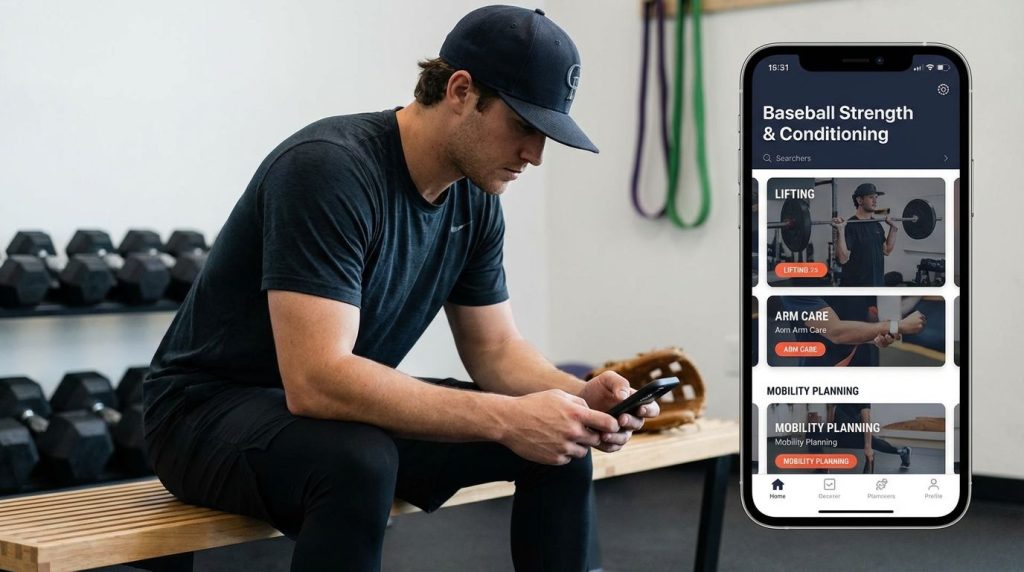
The top baseball strength and conditioning apps are the ones that keep your lifting, throwing-ready tissue work, and recovery organized around your actual baseball calendar, not a generic gym week. In 2026, the strongest mix of baseball-specific programming plus reliable training delivery comes from Peak Athletics, MPH Baseball, TrainHeroic, Volt Athletics, and GOWOD.
You are about to get a clear, coach-minded breakdown of what each app does well, who it fits, and where it can waste your time. You will also get a practical selection checklist you can use in under 10 minutes, plus a simple setup plan that keeps you consistent when school, work, practice, and games pile up.
App 1: Peak Athletics (Baseball-Specific Strength, Seasonal Plans, Arm Care)
If you want an app that is unapologetically built around baseball and softball strength and conditioning, Peak Athletics is positioned directly at that lane. It highlights baseball and softball athletes as the target user, and it calls out goals that match what actually matters on the field: performance gains, staying healthy, building power, and improving mobility. That matters because the best plan is the one that matches the real demands of your position, your throwing volume, and your season.
Peak leans into three things that separate a baseball S&C app from a generic workout tracker: a personalized schedule, specialty programs, and seasonal training options that include in-season and off-season choices. It also calls out arm care programs built to match the demands on pitchers’ arms across the season. When an app puts those elements front and center, it usually means the product is designed to reduce daily decision fatigue, you open the app and you know what training belongs on that day.
Where Peak tends to fit best is the athlete who wants one home base for strength work and baseball-relevant add-ons without needing a separate platform to “host” the plan. If you are a player who gets distracted by too many options, the schedule-first design is a real advantage. When you can see the upcoming week in one place, it becomes harder to drift into random workouts, and easier to stay aligned with the work that supports your throwing, hitting, sprinting, and durability.
App 2: MPH Baseball (Arm Care And Strength Built Around In-Season vs Off-Season)
MPH Baseball is a strong pick when arm health is a primary constraint, or when you already know that your program needs frequent, guided mobility and tissue prep work to hold up through the year. The MPH Arm Care App page is unusually clear about weekly frequency and how the plan shifts based on the season, which is what most athletes fail to manage on their own. You get a defined weekly rhythm instead of guessing how to blend lifting days with throwing days.
The MPH Full Version lists 3–5 strength and conditioning workouts per week that change based on in-season versus off-season needs, plus 5 arm care and mobility routines per week. It also states that routines frequently change, progress, and modify to match the time of season. That is a big deal for baseball because the cost of “set it and forget it” training is often shoulder irritation, elbow crankiness, or persistent stiffness that shows up right when you need to compete.
MPH also offers an arm-care-only option with the same weekly mobility and arm health emphasis, minus the strength and conditioning programming. That structure works well if your weight room plan already comes from a school program, a private coach, or a team lift, yet your arm still needs a dedicated plan. It is also direct about readiness expectations, recommending athletes be at least 15 or have basic lifting experience, which helps you avoid a mismatch between plan complexity and your current skill level.
App 3: TrainHeroic (Best For Following A Coach’s Baseball Program And Logging Progress)
TrainHeroic earns its place on a baseball S&C shortlist for one reason: a lot of credible strength coaches and performance facilities deliver their programming there. The app itself is not baseball-only, yet it is a reliable system for distributing a calendar, logging sessions, and communicating with a coach. When you already trust a program, your main need becomes execution, and execution is where a stable delivery platform wins.
TrainHeroic’s athlete support documentation emphasizes access to training “anytime and anywhere,” and it frames the mobile experience around the calendar and session logging. It also notes that if you have joined a coach or team, programming is commonly published to your calendar so you can start right away. That workflow matters in-season when you need speed: open the day, train, log, get out, recover, and move on.
TrainHeroic also supports athletes creating their own sessions when they do not have a coach, or when they want to track bonus work on rest days, plus it points athletes to the Marketplace to subscribe to programming with in-app coaching. For baseball players, that means TrainHeroic can be your “training operating system” even if your throwing plan sits elsewhere. The practical advantage is clean tracking, clear daily direction, and fewer missed sessions due to confusion about what to do.
App 4: Volt Athletics (Personalized S&C Delivery For Individuals, Teams, And Schools)
Volt Athletics belongs on this list because it is built for scaled strength and conditioning delivery, and it is used across organizations, coaches, and individuals. That matters when you are training inside a team setting where the staff wants consistency and visibility, or when you want an app that feels like a structured system rather than a loose collection of workouts. It positions itself as an AI-powered strength and conditioning solution and markets heavily toward coaches and organizations, yet it also offers an experience for individuals.
From an athlete standpoint, Volt is most valuable when your environment already runs on Volt, your school, facility, or coach assigns training through it, and you want a clear day-by-day plan with progression. In those cases, the “best app” is the one that keeps you aligned with the program your staff actually monitors. That alignment reduces friction, and reduced friction is what keeps you training consistently across months, not just during a motivated week.
Volt also highlights injury mitigation targets in certain sport descriptions, including areas that matter to baseball athletes, even when baseball is not explicitly the featured sport on the page excerpts. When an S&C system emphasizes injury mitigation as a primary training goal, it tends to fit athletes who need durable movement patterns and repeatable readiness, not just max-out days. If you are deciding between Volt and a baseball-only app, the deciding factor is usually who writes your plan and how much coaching support you want inside the platform.
App 5: GOWOD (Mobility Testing, Personalized Stretching Protocols, Recovery Support)
Baseball players often treat mobility like an optional add-on until the shoulder starts barking or the hips lock up mid-season. GOWOD is built to make mobility structured and measurable, which is why it works well as a companion to your lifting and throwing work. It positions the app around assessing mobility levels, identifying weaknesses, and creating personalized routines to target those limits.
GOWOD lays out a simple flow: create an account, take an in-app mobility assessment, then follow a protocol using the movement library or Premium protocols that adapt to your latest assessment score. It also emphasizes analytics, scoring, and identifying body zones impacting performance. For baseball, that can be useful when you need to keep overhead positions clean, keep the thoracic spine moving, and maintain hips that support rotation without compensations.
The baseball-specific page also ties mobility improvements to performance outcomes that match what you care about: smoother swings, stronger throws, agility, recovery, and injury risk reduction. Even without treating those claims as guarantees, the day-to-day value is real when the app keeps you consistent and targeted. If you keep missing mobility work because you “don’t know what to do,” a guided protocol can be the difference between occasional stretching and an actual mobility training habit.
How You Should Choose A Baseball Strength And Conditioning App (Season, Role, Equipment, Coaching)
Selection gets simple when you stop hunting for a “best” app and start filtering based on constraints. Your season determines your workload tolerance, your role determines your stress profile, and your equipment determines what you can execute without modifying every session. If the app does not match those constraints, you either skip sessions or you force sessions that do not fit, and both routes cost performance.
Start with your calendar: off-season training can support more volume, more lower-body strength work, more hypertrophy phases, and heavier progressions. In-season training needs tighter volume control and clearer intent, maintaining strength and power while managing soreness, travel, and game density. Apps that explicitly mention in-season and off-season options save you from guessing when to push and when to hold the line, which is the difference between building capacity and accumulating fatigue. ([peakathletics.io](https://peakathletics.io/))
Then evaluate your throwing demands. Pitchers usually need more frequent arm care and better monitoring of soreness and stiffness, position players still need shoulder health but often tolerate different weekly rhythms. If arm care is a priority, look for apps that state frequency and progression in plain language, not vague promises. If you already have a trusted coach, pick the platform that makes compliance easy, since the program quality comes from the coach and the consistency comes from the tool.
How To Avoid Getting Overtrained With An App (In-Season Rules That Actually Work)
Overtraining in baseball rarely happens because of one brutal workout, it happens because workloads stack up with no adjustment. Lifting volume stays high while throwing volume rises, then sprint work piles onto sore legs, then games compress recovery time. An app can protect you only if you use it to enforce rules, not to chase “more work” for its own sake.
Use three weekly anchors. Anchor one is lower-body strength and power support, anchor two is upper-body strength that respects shoulder positioning and scapular control, anchor three is arm care or mobility that keeps the shoulder, elbow, and thoracic spine functioning. When the app schedules those anchors consistently, you stop improvising and you start managing stress like a serious athlete. Apps that present a weekly schedule view or publish programming on a calendar make this easier because you see the week as a system, not a single workout.
Set a personal red-flag list and obey it. If elbow soreness spikes, reduce volume and intensity immediately and prioritize tissue quality, mobility, and recovery. If legs are heavy and sprint mechanics degrade, do not force max-effort speed work after a tough lower-body lift. The right app helps because it limits decision fatigue, but it still requires you to execute with discipline and to respect fatigue signals before they become injuries.
How To Combine Strength, Arm Care, And Mobility Without Wasting Time
Most baseball athletes do not fail due to lack of knowledge, they fail due to poor integration. Strength work, arm care, mobility, sprinting, and skill work compete for time, and the day only holds so much. Your best system is the one that keeps total time reasonable while still hitting the essentials at a high frequency.
One efficient structure is to place short mobility sessions on the same days as lifting, then keep a separate mobility-only day for restoration when games or practice are lighter. Apps like GOWOD are useful here because the routines can be short, guided, and personalized from an assessment, so you are not scrolling social media trying to invent a mobility plan. When the mobility plan adapts to a score, you can keep it objective and repeatable.
For arm care, frequency usually wins. MPH explicitly emphasizes multiple weekly arm care and mobility routines, and Peak highlights arm care programs designed for pitchers’ demands. If your throwing volume is high, treat arm care like brushing teeth: small doses, high consistency, no drama. When you align that with structured strength work, you protect your availability, and availability drives development more than any single “perfect” lift.
What To Track Inside The App So You Actually Improve (Not Just “Do Workouts”)
Progress is not “working hard,” progress is measurable output across months. Your app should help you track the few metrics that predict better performance and fewer breakdowns. The moment tracking becomes complicated, adherence drops, so the goal is tight, repeatable inputs.
Track load and consistency first. If the platform supports logging, use it every session, even when the day is light. TrainHeroic’s mobile app guidance centers on logging sessions and using the calendar, which supports that habit. If your app supports a weekly schedule view, use it as your compliance scoreboard: completed sessions per week, missed sessions per week, and reasons for misses.
Then track readiness in a way you can sustain. Simple works: sleep quality, soreness level, and throwing arm status. If your mobility app provides scores and analytics, use those scores monthly, not daily obsession, to keep the process objective. When you connect the dots between readiness and training choices, you protect performance under real baseball workloads instead of chasing gym numbers at the wrong time of year.
Best Baseball Strength And Conditioning App
- Baseball-specific plan: Peak Athletics
- Arm-care emphasis: MPH Baseball
- Coach-delivered programs: TrainHeroic
- Team or school system: Volt Athletics
- Mobility add-on: GOWOD
Build Your 2026 Training Stack And Stay On The Field
If you want one clean recommendation, select the app that matches how you train today, then lock in consistency for 8–12 weeks before switching tools. Peak Athletics and MPH Baseball stand out when baseball specificity and arm care must live inside the same system. TrainHeroic and Volt win when your training is tied to a coach, team, or organization that publishes structured work. Add GOWOD when mobility is the limiter, or when recovery needs to become a daily habit instead of an occasional stretch session.