
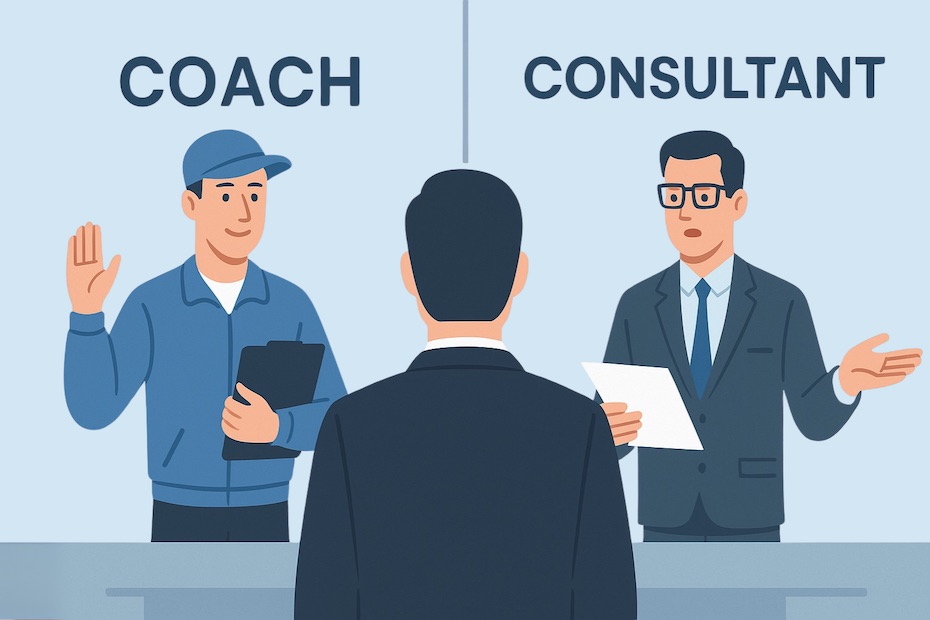
You hire a coach when you need to build leadership skills and accountability, and you hire a consultant when you need targeted expertise and execution.
This article helps you decide between a business coach and a consultant by clarifying their differences, benefits, and use cases. You’ll see when coaching drives long-term growth and when consulting solves immediate challenges, so you can confidently choose the right partner for your business.
What’s the difference between a coach and a consultant?
A coach helps you develop self-awareness, leadership ability, and accountability. A consultant brings specialized knowledge and delivers solutions for specific business challenges.
The distinction lies in approach. Coaches work with you to refine how you think and make decisions. Their role is to unlock your potential by asking the right questions, holding you accountable, and keeping you consistent in execution. Consultants, by contrast, analyze your problem, design a strategy, and often implement the solution themselves.
As an executive, you’ll notice the difference in outcomes. A coach strengthens your ability to solve problems independently, while a consultant provides an external fix designed for immediate results.
When should you consider hiring a business coach?
You bring in a coach when the priority is leadership development, cultural alignment, or personal performance growth. Coaches serve as accountability partners, guiding you through the hard work of self-improvement.
If you struggle with decision-making clarity, team communication, or maintaining discipline, a coach helps you establish systems and habits. Instead of prescribing answers, they push you to identify solutions yourself. This creates sustainable change, because you own the progress.
Executives often turn to coaches when preparing for succession planning, scaling leadership teams, or improving organizational alignment. The value comes not from quick answers but from long-term transformation.
When is a consultant the right solution?
A consultant is the right choice when your business faces a defined, technical, or operational problem. You hire a consultant for expertise you don’t have in-house and for solutions you want executed quickly.
Think of cases like restructuring a supply chain, implementing a new CRM, or building a digital marketing campaign. These problems require specialized knowledge and efficient execution. Instead of learning over time, you bring in someone who already knows the playbook.
Consultants also bring an external viewpoint that cuts through organizational blind spots. You pay for their ability to design and deliver solutions faster than your internal team could achieve.
What results can you expect from coaching versus consulting?
From coaching, you can expect incremental but lasting change in how you lead and make decisions. Over months, you’ll build resilience, sharpen strategy, and strengthen accountability in your team. Coaches don’t hand you a deliverable; they build your capacity to perform.
From consulting, you can expect clearly defined outputs—strategy documents, project roadmaps, or system implementations. A consultant provides structured solutions designed to solve problems within a set timeframe.
Put simply, coaching leaves you stronger, while consulting leaves your business better equipped in a specific function. Both outcomes are valuable; your choice depends on whether you’re prioritizing personal growth or operational execution.
What are the cost and commitment differences?
Coaching requires an ongoing investment of time and effort. Most coaching engagements run for months or even years, with recurring sessions that demand your participation. Progress depends on your commitment to the process.
Consulting, on the other hand, usually has a defined project scope, timeline, and deliverables. Costs are tied to the scale of the project, but the engagement ends once objectives are achieved.
You should weigh your decision on two factors: Do you want continuous guidance and accountability over time? Or do you want a one-time solution that fixes a pressing challenge?
How do you decide when you’re unsure which path to take?
When the choice isn’t obvious, start with a diagnostic conversation. Speak with both a coach and a consultant to see which approach resonates with your needs.
Ask yourself two questions: Do you need to build leadership strength for the long term? Or do you need external expertise to solve an immediate problem? If you answer yes to both, you may engage both at different stages. Many executives hire a consultant to fix operational challenges first, then transition to coaching for personal and cultural growth.
This dual approach ensures you don’t just solve problems—you also build the leadership discipline to prevent them from recurring.
Choosing Between a Business Coach and Consultant
- A coach develops leadership and accountability.
- A consultant delivers expert solutions and execution.
- Choose coaching for long-term growth, consulting for immediate problem-solving.
In Conclusion
The decision between a coach and a consultant comes down to your business needs. If you want to build leadership strength and sustainable habits, a coach is your best investment. If you face a specific challenge that requires fast, expert solutions, a consultant is the right choice. By aligning your decision with your priorities, you ensure that the guidance you invest in delivers measurable impact.
This article is about guiding others to their full potential. For more on my work in business development, coaching, and supporting students, head to my scholarship website